
Monitoring your blood pressure at home is one of the simplest things you can do for your long-term health, and the gap between a mediocre monitor and a good one mostly comes down to accuracy validation, cuff fit, and whether you will actually use it consistently. After looking at clinical validation data, long-term user feedback, and the practical differences between upper-arm and wrist designs, here are three monitors worth buying.
Quick Picks:
Best Overall: Greater Goods 0604 (~$33 (with 28% off on Amazon)) — The no-frills upper-arm monitor that Wirecutter has recommended five years running. Accurate, easy to read, and half the price of most competitors.
Best for Portability: Omron Gold BP4350 (~$78) — A clinically validated wrist monitor from the most trusted name in home blood pressure. Compact enough to toss in a bag.
Best for Connected Health: Withings BPM Connect (~$90) — Wi-Fi syncing means readings upload automatically without your phone nearby. The most seamless tracking experience available.
Best Overall: Greater Goods 0604
~$33 (with 28% off on Amazon) · Greater Goods · Amazon
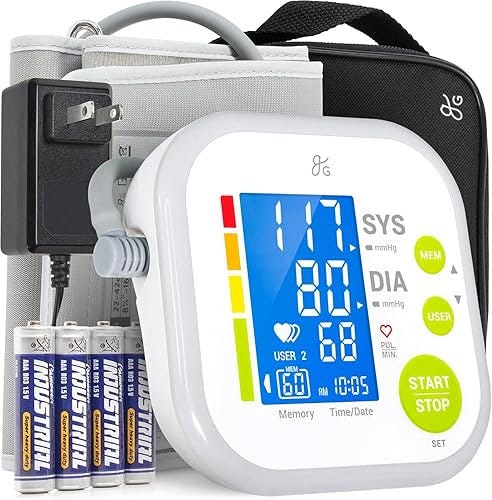
The Greater Goods 0604 is the blood pressure monitor equivalent of a Honda Civic: nothing flashy, nothing unnecessary, just reliable performance at a price that makes everything else feel like a markup for features you do not need. It has been a Wirecutter top pick for five consecutive years, which in the consumer health device world is an eternity. The wide-range cuff fits arms from 8.7 to 16.5 inches, which covers the vast majority of adults without needing to buy a separate large cuff.
The backlit LCD is large enough to read without glasses, and the one-touch operation means there is genuinely nothing to figure out. It stores 60 readings per user for two users (120 total), detects irregular heartbeats, and includes a color-coded indicator showing where your reading falls relative to AHA guidelines. It comes with a wall adapter, four AAA batteries, and a carrying bag.
The main trade-off is no Bluetooth or app connectivity. If you want to track trends digitally, you are writing numbers down or upgrading to the Greater Goods Bluetooth model (0604B). But for the person who just needs accurate readings and clear results—which is most people—this is the one to buy.
Best for Portability: Omron Gold BP4350
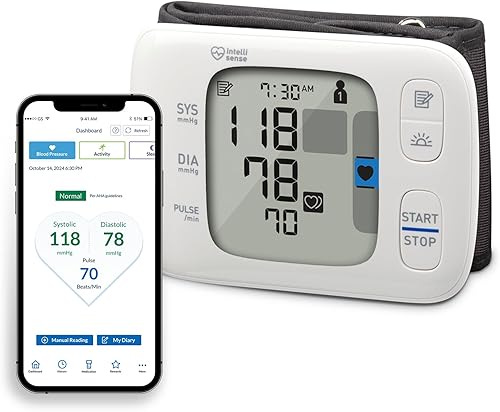
Omron is the brand your doctor’s office probably uses, and the Gold BP4350 brings that clinical credibility to a wrist-mounted design that is genuinely pocketable. Wrist monitors have historically been less accurate than upper-arm models, but the BP4350 is clinically validated to ANSI/AAMI/ISO standards, and Omron’s positioning guide helps you hold your wrist at heart level—the key variable that trips up most wrist readings.
It connects via Bluetooth to the Omron Connect app (iOS and Android), which stores unlimited readings and lets you share data with your doctor. The device itself holds 200 readings for two users. The display is clear and the readings are fast—typically under 30 seconds from button press to result.
The caveat with any wrist monitor is technique. If you do not keep your wrist at heart level during measurement, readings will skew. For people who travel frequently or find upper-arm cuffs uncomfortable, the BP4350 is the most trustworthy wrist option available. For everyone else, an upper-arm monitor will be more forgiving of imperfect positioning.
Best for Connected Health: Withings BPM Connect
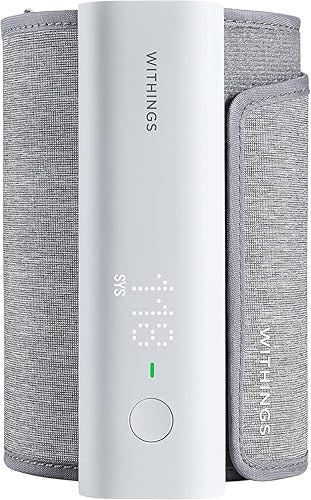
The Withings BPM Connect is the only blood pressure monitor that syncs readings over Wi-Fi, which means you do not need your phone in the room when you take a measurement. Take a reading at 6 AM, and by the time you check the Withings Health Mate app over coffee, it is already there. For people managing hypertension who need to track daily readings for their doctor, this passive syncing removes the single biggest friction point in consistent monitoring.
The device itself is FDA-cleared, clinically validated, and covers arm circumferences from 9 to 17 inches with a single cuff size. It charges via micro-USB and lasts about six months on a single charge. The LED matrix on the cuff gives you an immediate color-coded reading (green/orange/red) so you get instant feedback even without the app. It also integrates with Apple Health.
At $90, it costs nearly three times the Greater Goods, and the Health Mate app has been pushing a Withings+ subscription ($9.95/month) for some advanced features. The core blood pressure tracking remains free, but the subscription nudging has annoyed longtime users. If you want the smartest tracking ecosystem and do not mind paying for it, the BPM Connect is unmatched. If you just need accurate readings, the Greater Goods does the job for a third of the price.